The primary function of media is not to communicate information but to coordinate behavior.
retweet from @DanielPinchbeck
Wednesday, 30 October 2013

Monday, 28 October 2013

Deny Deny Deny!
Scientific Denial-ism
Through another class, I came across a paper about "denialism" concerning health issues. However, the essence and tactics of denying something spans pretty much all topics, and the paper and related blogs quoted creationalism, AIDS, tobacco and global warming as being under attack using the same methods.(upon inspection, it looks to me like the tactics may have really been first published relating to climate change anyways on a blog. see Below.)
The general definition of scientific denialism is the "the employment of rhetorical arguments to give the appearance of legitimate debate where there is none, an approach that has the ultimate goal of rejecting a proposition on which a scientific consensus exists" (Diethelm P and McKee M).
Deniers implement five main tactics: conspiracy, cherry-picking, fake experts, impossible expectations and general fallacies of logic (Diethelm P and McKee M). The journal article touches lightly on them but Mark at Science Blogs goes into each one very nicely in his personal blog. My favorite trusty ol' website Skeptical Science does as well.)

Denialism is simply about the tactics used to hinder thoughtful and valid communication. Every scientist can not argue with every single person that doesn't believe in climate change (though can lead to some very entertaining and very long blog comments!) However if the common mass, or even better, the media itself can recognize what is being done, a more useful debate can take place.
My favorite point comes from Mark at science blogs. He points out that these denialists have the upper hand by being virtually unlimited by make things up, whereas the scientists are limited by data and have to devalue each error described by the opposer. They aren't interested in the truth or data, just that what they say is the last word (Hoofnagle M).
The general public often believe what is erroneously portrayed because the argument is NOT as wild or frightening, as opposed to hearing you will be under water from X cm of sea level rise, for example. They prey on emotions and are therefore very influential on the mostly uninformed general public
In going, the point is: don't bother arguing with the "cranks" (you will be there all day), but DO discuss data and science with those that really want to have a legitimate conversation and become informed.
Cook J. Skeptical Science. The Five Characteristics of Scientific Denialism. Accessed 28 October 2013. http://www.skepticalscience.com/5-characteristics-of-scientific-denialism.html
Diethelm P and McKee M. Denialism: What is it and How Should Scientists Respond. European Journal of Public Health. 2009. Vol. 19, No. 1, 2–4.
Hoofnagle M. Denialism Blog. 2007. Accessed 28 October 2013. http://scienceblogs.com/denialism/about/
"Just because some people believe in stupid things, doesn’t make them denialists."
Mark Hoofnagle
Through another class, I came across a paper about "denialism" concerning health issues. However, the essence and tactics of denying something spans pretty much all topics, and the paper and related blogs quoted creationalism, AIDS, tobacco and global warming as being under attack using the same methods.(upon inspection, it looks to me like the tactics may have really been first published relating to climate change anyways on a blog. see Below.)
The general definition of scientific denialism is the "the employment of rhetorical arguments to give the appearance of legitimate debate where there is none, an approach that has the ultimate goal of rejecting a proposition on which a scientific consensus exists" (Diethelm P and McKee M).
Deniers implement five main tactics: conspiracy, cherry-picking, fake experts, impossible expectations and general fallacies of logic (Diethelm P and McKee M). The journal article touches lightly on them but Mark at Science Blogs goes into each one very nicely in his personal blog. My favorite trusty ol' website Skeptical Science does as well.)

Denialism is simply about the tactics used to hinder thoughtful and valid communication. Every scientist can not argue with every single person that doesn't believe in climate change (though can lead to some very entertaining and very long blog comments!) However if the common mass, or even better, the media itself can recognize what is being done, a more useful debate can take place.
My favorite point comes from Mark at science blogs. He points out that these denialists have the upper hand by being virtually unlimited by make things up, whereas the scientists are limited by data and have to devalue each error described by the opposer. They aren't interested in the truth or data, just that what they say is the last word (Hoofnagle M).
The general public often believe what is erroneously portrayed because the argument is NOT as wild or frightening, as opposed to hearing you will be under water from X cm of sea level rise, for example. They prey on emotions and are therefore very influential on the mostly uninformed general public
In going, the point is: don't bother arguing with the "cranks" (you will be there all day), but DO discuss data and science with those that really want to have a legitimate conversation and become informed.
Cook J. Skeptical Science. The Five Characteristics of Scientific Denialism. Accessed 28 October 2013. http://www.skepticalscience.com/5-characteristics-of-scientific-denialism.html
Diethelm P and McKee M. Denialism: What is it and How Should Scientists Respond. European Journal of Public Health. 2009. Vol. 19, No. 1, 2–4.
Hoofnagle M. Denialism Blog. 2007. Accessed 28 October 2013. http://scienceblogs.com/denialism/about/
Thursday, 17 October 2013
Literature Review: Who Speaks for the Climate?
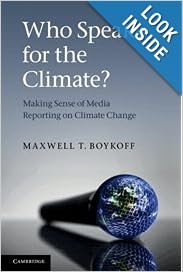
Boykoff, M.T. Who Speaks for the Climate: Making Sense of media reporting on climate change. 2011. Cambridge University Press.
This well researched book was written by Maxwell T. Boykoff, an Assistant Professor and Research Associate in the U.S. and U.K. He covers the topic of media coverage of climate very extensively and touches on cultural politics science complexity, and journalistic norms. He even coined a new term "Ccarbonundrums" about interpretations from the public.
Some points covered:
VOCABULARY:
What do you currently call the situation: climate change, global warming, global weirdness (it was found that global warming invoked a more emotional response than climate change.)
Instead of greenhouse gas emissions, heat trapping emissions is easier for non technical people to understand.
CLIMATE IMAGES:
Images are very important to show effects and have people know what is going on at locations around the globe. It was cautioned that "not all environmental problems can be seen" (Doyle 2007 as cited in Boykoff 2011) However, dramatic images do raise awareness and concern but can lead the public to actually become disengaged because they then felt scared or helpless (pg 16.)
UNCERTAINITIES:
"Greater scientific understanding can actually lead to more complicated policy decision making" by which there is now more material to argue and question (Sarewitz 2004 as cited in Boykoff 2011).
The word "uncertainty" is very powerful and cast large doubt, regardless of the range of uncertainty.
SCIENTISTS AND THE MEDIA
Scientists who become involved with media and political debates can put their reputations at risk and little professional payoff is gained. This became even more obvious after the infamous Climategate. Their is a belief that scientists have an obligation to be public but that they won't or are just boring. (There was an actual newspaper who's headline read "Actual expert too boring for TV" (pg 72.)
The book includes multiple graphs and "woordels" but a few of the more interesting (I think) ones are here:

Newspaper coverage of climate change/global warming for seven years in 50 newspapers in 20 countries (Boykoff pg 25).

Atmospheric temperatures and media coverage of climate change (Boykoff pg 31).
Uk tabloid headlines by specific area (Boykoff pg 94).
Tuesday, 8 October 2013
Great websites to share
An eclectic list of Climate/environmental
sites that are relevant to the topic or that I find interesting:
http://grist.org/ (my absolute favorite!)

Introduction to the blog for module GEOGG131
"We don’t have time for a meeting of the Flat Earth Society. Sticking your head in the sand might make you feel safer, but it’s not going to protect you from the coming storm.”
President Obama’s energy policy speech at Georgetown University June 2013
The reader may have noticed that the address for this blog is flatearthsocietyblog. I thought it was rather clever when I watched President Obama’s speech and delighted me as a geography graduate. It turns out that there actually IS a real Flat Earth Society in full force today.
Though to give them credit, Society President Daniel Shenton does “… believe the evidence available does support the position that climate change is at least partially influenced by human industrialisation." I choose the name because once upon a time not too long ago, people ‘knew’ that their world was flat because that’s what they were taught. Changing people’s known facts and convictions are difficult.
 |
| deviantart.com |
Though to give them credit, Society President Daniel Shenton does “… believe the evidence available does support the position that climate change is at least partially influenced by human industrialisation." I choose the name because once upon a time not too long ago, people ‘knew’ that their world was flat because that’s what they were taught. Changing people’s known facts and convictions are difficult.
The quote refers to deniers of anthropogenic climate change as ‘members’ of a Flat Earth Society, but this blog WON’T only be about deniers or misinformation, but also the exaggerations (purposeful or not) presented in the mass media. I will dabble in a range of sources from academic journals and published materials to popular news stations and websites. Accurate but realistic communication to the general masses is utterly important to topics like this. Ninety seven percent of scientists agree that climate change is happening due to human activities and it is time for ninety seven percent of the public to know it is true.
So whether one believes that they will fall off the edge of the world or that humans aren’t drastically altering the climate, it is because this is what was communicated to them. The act of relaying scientific information to the general population is a huge responsibility that should not be taken advantage of.
Subscribe to:
Posts (Atom)