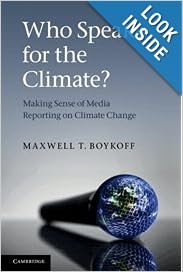
Boykoff, M.T. Who Speaks for the Climate: Making Sense of media reporting on climate change. 2011. Cambridge University Press.
This well researched book was written by Maxwell T. Boykoff, an Assistant Professor and Research Associate in the U.S. and U.K. He covers the topic of media coverage of climate very extensively and touches on cultural politics science complexity, and journalistic norms. He even coined a new term "Ccarbonundrums" about interpretations from the public.
Some points covered:
VOCABULARY:
What do you currently call the situation: climate change, global warming, global weirdness (it was found that global warming invoked a more emotional response than climate change.)
Instead of greenhouse gas emissions, heat trapping emissions is easier for non technical people to understand.
CLIMATE IMAGES:
Images are very important to show effects and have people know what is going on at locations around the globe. It was cautioned that "not all environmental problems can be seen" (Doyle 2007 as cited in Boykoff 2011) However, dramatic images do raise awareness and concern but can lead the public to actually become disengaged because they then felt scared or helpless (pg 16.)
UNCERTAINITIES:
"Greater scientific understanding can actually lead to more complicated policy decision making" by which there is now more material to argue and question (Sarewitz 2004 as cited in Boykoff 2011).
The word "uncertainty" is very powerful and cast large doubt, regardless of the range of uncertainty.
SCIENTISTS AND THE MEDIA
Scientists who become involved with media and political debates can put their reputations at risk and little professional payoff is gained. This became even more obvious after the infamous Climategate. Their is a belief that scientists have an obligation to be public but that they won't or are just boring. (There was an actual newspaper who's headline read "Actual expert too boring for TV" (pg 72.)
The book includes multiple graphs and "woordels" but a few of the more interesting (I think) ones are here:

Newspaper coverage of climate change/global warming for seven years in 50 newspapers in 20 countries (Boykoff pg 25).

Atmospheric temperatures and media coverage of climate change (Boykoff pg 31).
Uk tabloid headlines by specific area (Boykoff pg 94).

No comments:
Post a Comment